

Gitxaała Nation’s recent decision in the BC Court of Appeal (BCCA) in Gitxaala v. British Columbia (Chief Gold Commissioner), 2025 BCCA 430 that incorporates the United Nations Declaration on the Rights of Indigenous Peoples (UNDRIP) into positive law is getting attention. While media outlets are focused on David Eby’s commitment to amending the Declaration on the Rights of Indigenous Peoples Act (DRIPA) — undermining the rule of law and potentially reversing decades of reconciliation — behind the scenes, there’s a company trying to further undermine Indigenous rights – Canadian Nuclear Laboratories (CNL).
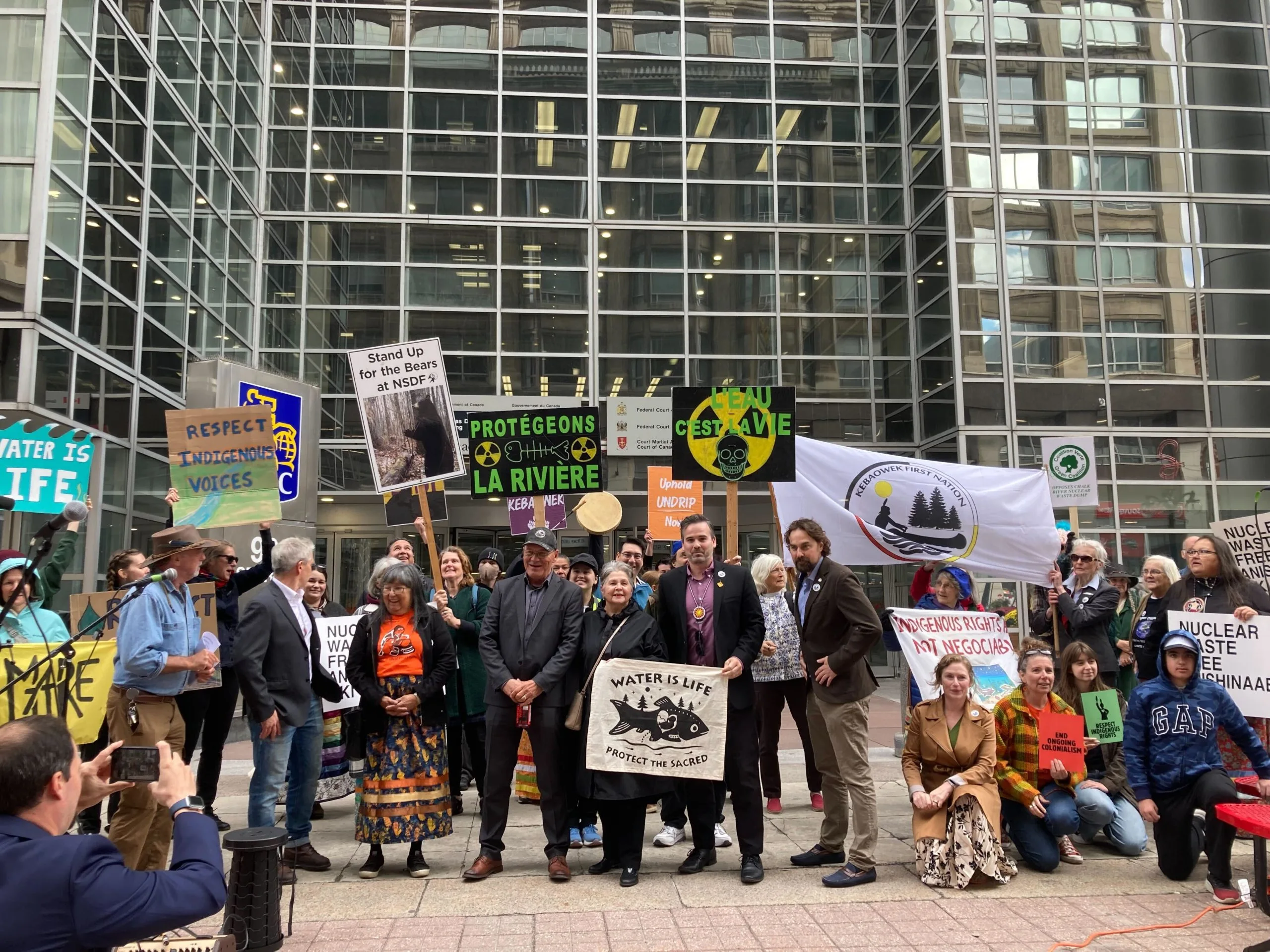
CNL recently filed a submission in Kebaowek First Nation’s case over the proposed nuclear waste facility on their territory, a legal case that RAVEN has supported for almost two years. If built in its current location, the facility would hold over one million cubic metres of nuclear waste just one kilometre from the Kichi Sibi (Ottawa river), which provides millions of people with clean drinking water.
Kebaowek recently went to the Federal Court of Appeal with CNL, who is seeking to overturn the need for the First Nation’s free, prior, and informed consent over the consultation process to build the nuclear waste facility. You can read more about the decision and why Kebaowek cross-appealed here.
With the BCCA decision in Gitxaała’s case being such a powerful precedent that incorporates UNDRIP, the Federal Court judges gave CNL and Kebaowek the opportunity to make new submissions specifically about this decision. Not only does this show how interconnected Indigenous-led litigation is (which RAVEN is integral to in supporting both cases), but it also allows for both sides to share new perspectives.
The Submissions
CNL’s response with a new submission to the courts argues that Gitxaała’s case is “wholly distinguishable” from their case, and that it doesn’t alter the one sole point that CNL is relying on: consultation with Kebaowek was fulfilled. They comb through the specific differences between DRIPA and Canada’s own United Nations Declaration on the Rights of Indigenous Peoples Act (UNDA) in attempts to show how UNDA shouldn’t be taken the same way as DRIPA. CNL also criticizes two aspects of the BCCA’s decision in Gitxaala v. British Columbia as “unsupported statements of law.”
Is that fear we are picking up on in CNL’s submission? Or is it just pure hypocrisy?
CNL previously argued that DRIPA “is very similar to the [Federal] UNDRIP Act” when the BC Supreme Court ruled more in favour of CNL’s arguments. Switching this narrative is an attempt to downplay the importance of the United Nations Declaration on the Rights of Indigenous Peoples (UNDRIP) in Canada.
CNL’s new arguments also agitate Kebaowek’s perspective; their UNDRIP rights, which should be incorporated into positive law as declared by the Supreme Court of Canada, were violated when a nuclear waste facility was approved by the Canadian Nuclear Safety Commission (CNSC). Section 29 of UNDRIP requires the free, prior, and informed consent of Indigenous Peoples before any hazardous materials are stored on their territories. Kebaowek has the right to a new consultation process that truly integrates consent and allows the First Nation to make informed decisions about the location of a nuclear waste facility on their territory.
Kebaowek has submitted a response to the Federal Court of Appeal regarding CNL’s submission, saying the Gitxaala v. British Columbia case is similar to Kebaowek’s case. Both have similar legal issues and even similar statutes taken from UNDRIP that are being violated. Ultimately, the cases lead to UNDRIP playing a central role in interpreting the Crown’s Duty to Consult, and the CNSC ought to have at least considered Kebaowek’s rights under UNDRIP when approving the nuclear waste facility.
The Reality
Unfortunately, instead of navigating toward reconciliation between the Crown, industry, and Indigenous Peoples, we are witnessing more conflict and tension than before. UNDRIP and its incorporation into positive law in Canada should be something to celebrate with clear pathways toward long-term economic development and environmental protections while honouring Indigenous rights and their territories. Working in a good way with First Nations, like Kebaowek, is crucial for getting decisions right, especially in a world with a rapidly accelerating climate, sincere threats to democratic processes, and a troubling shift of public support away from reconciliation.
In 2007, Canada and three other nation-states initially opposed the ratification of UNDRIP. They opposed enshrining the human rights of Indigenous Peoples on an international stage. That – and much, much worse – will always be a part of our dark history in Canada. Unless we see a real shift in accountability and action, future generations will view this time period and the responses by industry and the Crown as another era of oppression.
But, even if the decision is overturned and Kebaowek doesn’t have their day at the Supreme Court of Canada; even if David Eby is successful in reducing the legal teeth of UNDRIP for Indigenous Peoples to use in B.C.’s courtrooms; even if something similar happens to UNDA; there will be no end to pursuits for justice. UNDRIP rights are fundamental human rights of Indigenous Peoples that are just now being recognized through colonial doctrines. These rights have existed since time immemorial in their own beautiful and unique ways, and although injustice is present, the people will continue to resist, and justice shall persist.
If you can, donate to Kebaowek as the response to CNL’s submissions bears a financial cost.