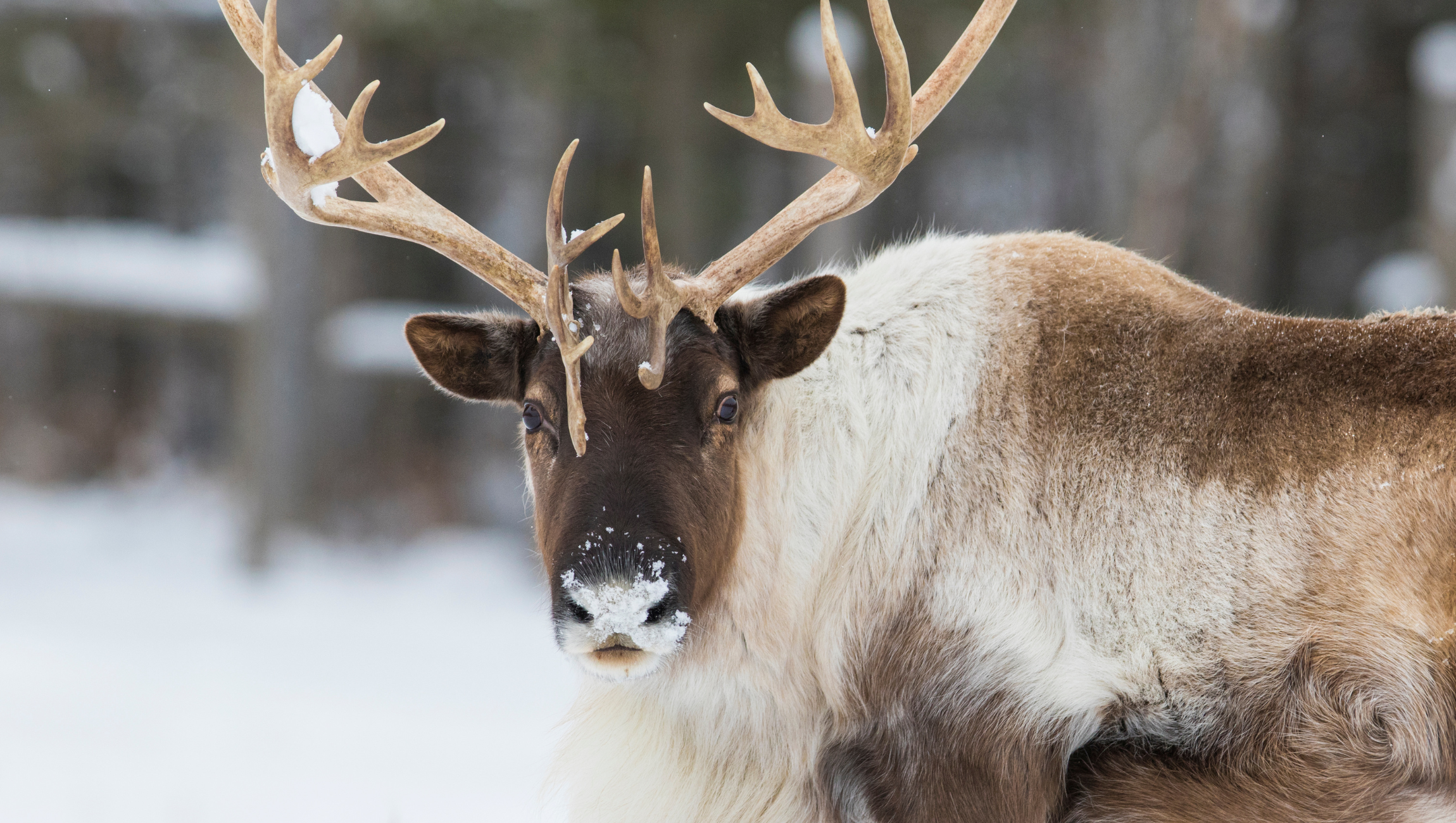
Athabasca Chipewyan First Nation (ACFN) has seen devastating effects from industrial development on their territory, notably the Kearl tailings discharge into the Athabasca River. They have a deep, inherent obligation to care for the lands and waters of their territory, and they’re enacting their sovereignty with a stewardship plan for tâdzié / sagow atihk, or Woodland Caribou, which are a culturally significant species for ACFN and other local Nations.
Alongside the Mikisew Cree First Nation (MCFN), ACFN created the Tâdzié-Sagow Atihk Stewardship Plan, an innovative, living document that outlines exactly how ACFN wants to recover Woodland Caribou (tâdzié in Dené; sagow atihk in Cree). The goal is to:
“Recover tâdzié / sagow atihk populations to the extent that ACFN and MCFN can once again rely on tâdzié / sagow atihk for subsistence and cultural practices. This full goal must be met in no longer than 40 years, with measurable and verified progress being achieved in set periods within that timeline. To meet this goal, knowledge holders identified a target of 80% undisturbed habitat within tâdzié / sagow atihk ranges by 2061, with calving habitats targeted at 100% disturbance-free. In addition to being disturbance-free, this habitat must contain all of the qualities required by tâdzié / sagow atihk to meet their needs throughout each season.”
Indigenous laws, traditions, and knowledge are actionized through the plan in a way that is consistent with Canadian law, forcing governments and industries to respect ACFN’s leadership with this plan. It shows how serious, dedicated, and fearless ACFN is in stewarding their lands and waters to recover tâdzié / sagow atihk populations.
History and Current Status
ACFN and MCFN historically and presently manage the habitat of tâdzié / sagow atihk for abundance. Wetlands, streams, and lakes meander around deciduous and coniferous trees, creating a boreal habitat that hosts other important species – moose, wolves, and black bears are some keystone species, while songbirds and waterfowl join resident owls on their migrations through the territory. ACFN and MCFN’s homelands have managed these relations successfully since time immemorial.
One large herd used to roam all throughout ACFN and MCFN’s territories, but because of habitat fragmentation caused by oil, gas, forestry, and wildfires, there are now four separate herds. These four herds are in four distinct areas that have suitable habitat for their recovery – the Richardson, Red Earth, East of the Athabasca River, and West of the Athabasca River ranges. These areas are seen on the map below, which includes habitat suitability for tâdzié / sagow atihk:
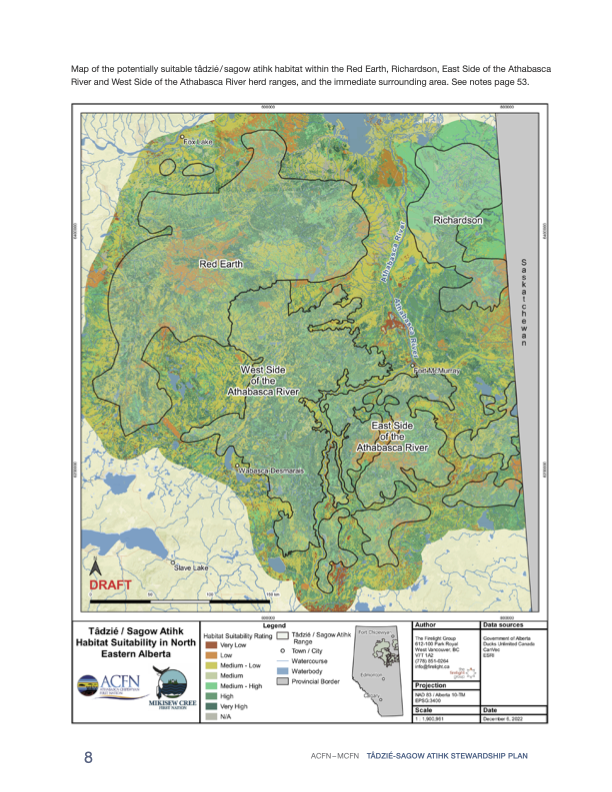
Industrial development has contributed to significant degradation and fragmentation of intact boreal habitat, resulting in the ongoing decline of tâdzié / sagow atihk. Most of the land has been affected by seismic lines from oil and gas development, which are 3 to 10 metre wide corridors of clear-cut boreal forest to transport hydrocarbon survey equipment. These seismic lines contribute to habitat fragmentation in the long-term and range in density across all four suitable ranges for tâdzié / sagow atihk, with the highest amount of disturbed land from seismic lines being 84% (East of the Athabasca River). Other disturbances include forestry, wildfires, and pipelines, leaving only around 14% of the land undisturbed.
In 2022, there were a combined 563 individuals of tâdzié / sagow atihk across all four ranges, with an estimated 50% decline rate occurring every eight years. In order to keep tâdzié / sagow atihk from collapsing completely, 65% of all ranges need to be maintained in an undisturbed condition to allow for even a 60% chance of the herds being able to be self-sustaining. Three of the four herds are “very unlikely to be self-sustaining” and will need intervention.
Although the situation is dire for tâdzié / sagow atihk, ACFN and MCFN have an incredible plan to save the culturally-significant species from extinction, asserting their sovereignty and Treaty 8 rights in the process.
The Plan
There are four main components to ACFN and MCFN’s stewardship plan for tâdzié / sagow atihk. They are:
- Create an Elders Declaration to guide the stewardship of tâdzié / sagow atihk according to Dené and Cree laws;
- Identify stewardship zones to achieve habitat target goals;
- Create the Tâdzié-Sagow Atihk Guardianship Plan to monitor the status of the threatened species; and
- Develop stewardship protocols using Dené and Cree knowledge to guide industry, government, and other organizations to implement the plan.
The Elders Declaration was created in August 2022, shortly after the stewardship plan was released. It is supposed to describe the laws, rules, and regulations that ACFN and MCFN have set out for government and industry to abide by. This initiative is an incredible assertion of sovereignty and their Treaty 8 rights that demonstrates how beneficial Indigenous sovereignty is for the lands, waters, and air we all depend upon. It is a legal document that ACFN and MCFN have that is not publicly available at this moment in time.
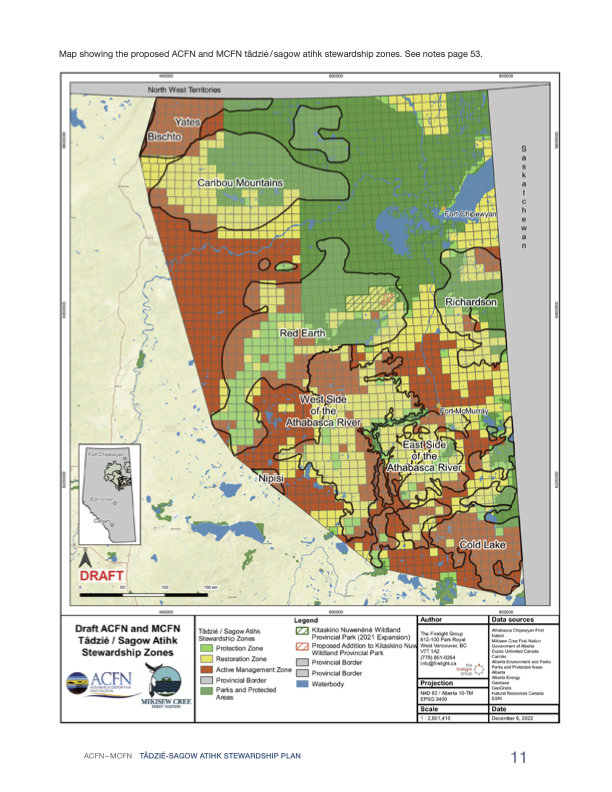
The stewardship zones are habitats distinguished both through traditional ecological knowledge of tâdzié / sagow atihk on the land and current telemetry data. Intact muskeg and boreal forests are the highest priority, but ACFN also understands the importance of restoring degraded habitat for the species to properly recover. The goal is to achieve at least 65% undisturbed habitat at the range level (for each range, it reaches a 65% undisturbed rate), with the stretch goal being 80%.
There will be three different types of stewardship zones – protection, restoration, and active management. Protection and Restoration zones are defined as land that should be protected or restored to an undisturbed level. An Active management zone is an area where land has been heavily disturbed by industry. Industry can operate within these areas under limitations guided by ACFN and MCFN, which include habitat offsetting by restoration elsewhere. Check out the full report to see how exactly the First Nations delineate what land gets put into what category. Below is the map of what area is designated for each zone:
The Tâdzié-Sagow Atihk Guardianship Plan is an initiative for ACFN and MCFN members to be out on the land to monitor tâdzié / sagow atihk. It honours how past and current members have had to stop hunting because of low and declining numbers; knowing this comes from a deep knowledge of the tâdzié / sagow atihk that wouldn’t have been learned without being on the land. ACFN and MCFN believe it’s crucial for their knowledge holders to lead land-based monitoring of tâdzié / sagow atihk according to their stewardship principles, which has led to the creation of the Guardianship Plan.
In the plan, the relevance of guardianship for the stewardship plan to work is integral:
“The urgency of this need is difficult to overstate: while the values of both nations are fundamentally based on the integrity of the boreal ecosystem, the loss of a specific use leads over time to a decline in knowledge surrounding that value. Reconnecting the community, and particularly youth from the two nations, to the cultural value of tâdzié / sagow atihk is a critical component of maintaining the integrity of the boreal ecosystem” (p. 55).
Lastly, creating stewardship protocols for government and industry to follow is essential for implementing the plan and is a part of ACFN and MCFN asserting their sovereignty and rights as signatories of Treaty 8. These stewardship protocols are grounded in care and reciprocity for tâdzié / sagow atihk that responds to cultural sensitivities for the species. For example, ACFN and MCFN don’t want to use radio collars to track the species as they view it as animal cruelty for tâdzié / sagow atihk to wear; they point to the Guardians Program as a solution for not needing radio collars on the animals, as Guardians can be out on the land tracking them. Another example is with strongly opposing the culling and poisoning of wolves, a predator species of tâdzié / sagow atihk; a culturally appropriate wolf trapping program may be implemented if necessary, but the main focus of the First Nations is to limit industrial development, as they know the species’ decline is human-caused.
To further implement the stewardship plan, ACFN and MCFN are using national legislation to keep Canada accountable to recovering tâdzié / sagow atihk. Both First Nations have signed a Section 11 agreement under the Species at Risk Act with Canada to protect and recover tâdzié / sagow atihk. This aligns with Canada’s international commitments to biodiversity and climate change, including the United Nations Declaration on the Rights of Indigenous Peoples.
Conclusion
Industrial development, largely permitted by Alberta and Canada without ACFN’s consent, has been running roughshod over Treaty 8 rights for well over a century. Lands that were once managed for abundance by ACFN are now unable to sustain tâdzié / sagow atihk populations because of forced jurisdiction of colonial governments, so industry can extract resources and make money.
With the leadership of ACFN and MCFN, that is now changing. The Tâdzié-Sagow Atihk Stewardship Plan is not just a hopeful symbol in recovering a culturally-significant species, it’s a symbol that ACFN is not going to put up with the status quo of development from industry that’s authorized by government. A new era is upon us. Indigenous Nations are reasserting their sovereignty to enforce land management practices according to their own laws and protocols, forcing industry and government to honour the lands and waters we all rely on. ACFN’s legal case is just another version of that assertion of sovereignty.
Tâdzié / sagow atihk will be able to recover if Canada and Alberta abide by the stewardship plan that ACFN and MCFN have set in place. Support ACFN with their legal case in reasserting their Treaty 8 rights, which will in turn protect their lands and waters from unsustainable development that is leading to the loss of tâdzié / sagow atihk.