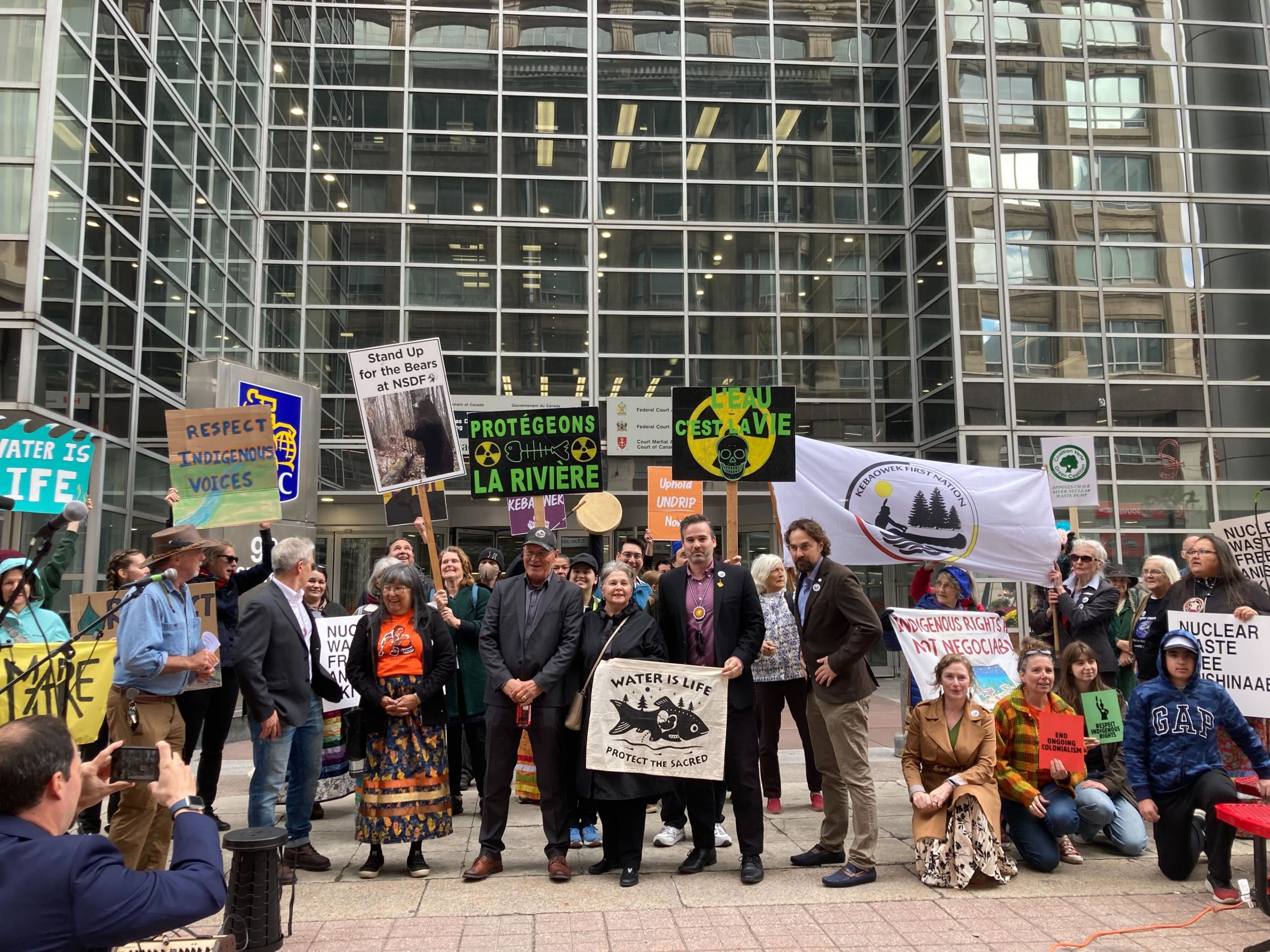
Next week, Kebaowek First Nation leaders will travel to Ottawa to speak at the Assembly of First Nations Forum on Nuclear Waste Management, drawing national attention to one of the most significant Indigenous rights and environmental justice cases currently before the courts in Canada.
Chief Lance Haymond and Councillor Justin Roy, alongside members of the community delegation, will speak about their Nation’s ongoing efforts — including active litigation — to protect the Kichi Sibi, known today as the Ottawa River, from a proposed nuclear waste disposal facility at Chalk River Laboratories.
This comes at a critical moment.
Kebaowek First Nation has challenged the federal approval of a massive nuclear waste disposal facility located less than one kilometre from the Kichi Sibi. The project, proposed by Canadian Nuclear Laboratories, would involve the disposal of approximately one million cubic metres of radioactive and hazardous waste in a near-surface mound on unceded Algonquin territory.
The Kichi Sibi is a sacred river that supports diverse ecosystems and provides drinking water to millions of people downstream in both Ontario and Quebec. The surrounding lands are home to culturally and ecologically significant species, including moose, black bear, wolf, lake sturgeon, and American eel. Kebaowek leaders have raised serious concerns about the long-term risks the project poses to the watershed and future generations.
“This is not only a First Nation issue,” Chief Lance Haymond has said. “It’s a human issue.”
In a landmark decision issued in February 2025, the Federal Court found that the Canadian Nuclear Safety Commission failed to adequately consider the United Nations Declaration on the Rights of Indigenous Peoples (UNDRIP) when assessing whether the duty to consult had been fulfilled. The Court directed that consultation must be resumed in a more robust manner, consistent with UNDRIP principles, including the objective of achieving free, prior, and informed consent (FPIC).
UNDRIP, which Canada committed to implementing into federal law through the United Nations Declaration on the Rights of Indigenous Peoples Act in 2021, affirms that hazardous materials should not be stored or disposed of on Indigenous lands without the free, prior, and informed consent of Indigenous Peoples (Article 29(2)).
Kebaowek’s case is helping to define how these principles are applied in Canadian law — particularly how FPIC informs the Crown’s duty to consult and accommodate in decisions involving high-risk industrial projects.
At the same time, the Nation is advancing its own legal and governance framework. Kebaowek’s Rights and Responsibilities Assessment Law represents the Nation’s formalization of its own free, prior, and informed consent (FPIC) process — a community-driven framework grounded in Indigenous laws, stewardship responsibilities, and reciprocal relationships with land and water. Developed in direct response to the Federal Court’s 2025 decision, the law establishes how Kebaowek will assess, deliberate, and ultimately grant or withhold consent on projects affecting its territory.
Importantly, this law is not theoretical — it is being actively applied. As consultation on the proposed nuclear waste facility resumes, as directed by Justice Blackhawk in the Federal Court decision on Kebaowek First Nation v. CNSC, Kebaowek is implementing this process in real time to ensure that any path forward reflects its laws, decision-making structures, and the objective of achieving FPIC. In doing so, the Nation is setting a clear and practical standard for how Indigenous consent can be meaningfully operationalized in Canada.
Rather than simply responding to harmful development, Kebaowek is asserting a forward-looking vision — one where Indigenous Nations exercise their inherent jurisdiction and are respected as decision-makers in matters affecting their lands and waters.
Supporters across the country now have an opportunity to stand with them. As Kebaowek leaders bring their message to Ottawa, they are asking people to recognize that protecting water, upholding Indigenous rights, and safeguarding future generations are inseparable.
There are several ways to take action:
- A federal House of Commons petition is currently open, calling on the Government of Canada to respect Indigenous consent in decisions related to nuclear waste and other high-risk projects.
- Donations can be made to support Kebaowek First Nation’s ongoing legal efforts.
- Individuals can also visit the Nation’s campaign site to learn more and get involved.